

By Mary Emmanuel
UYO
The Akwa Ibom governor, Pastor Umo Eno, has reaffirmed his administration’s unwavering commitment to revitalizing the state’s power sector and partnering with relevant stakeholders to restore critical electricity infrastructure for sustainable economic development.
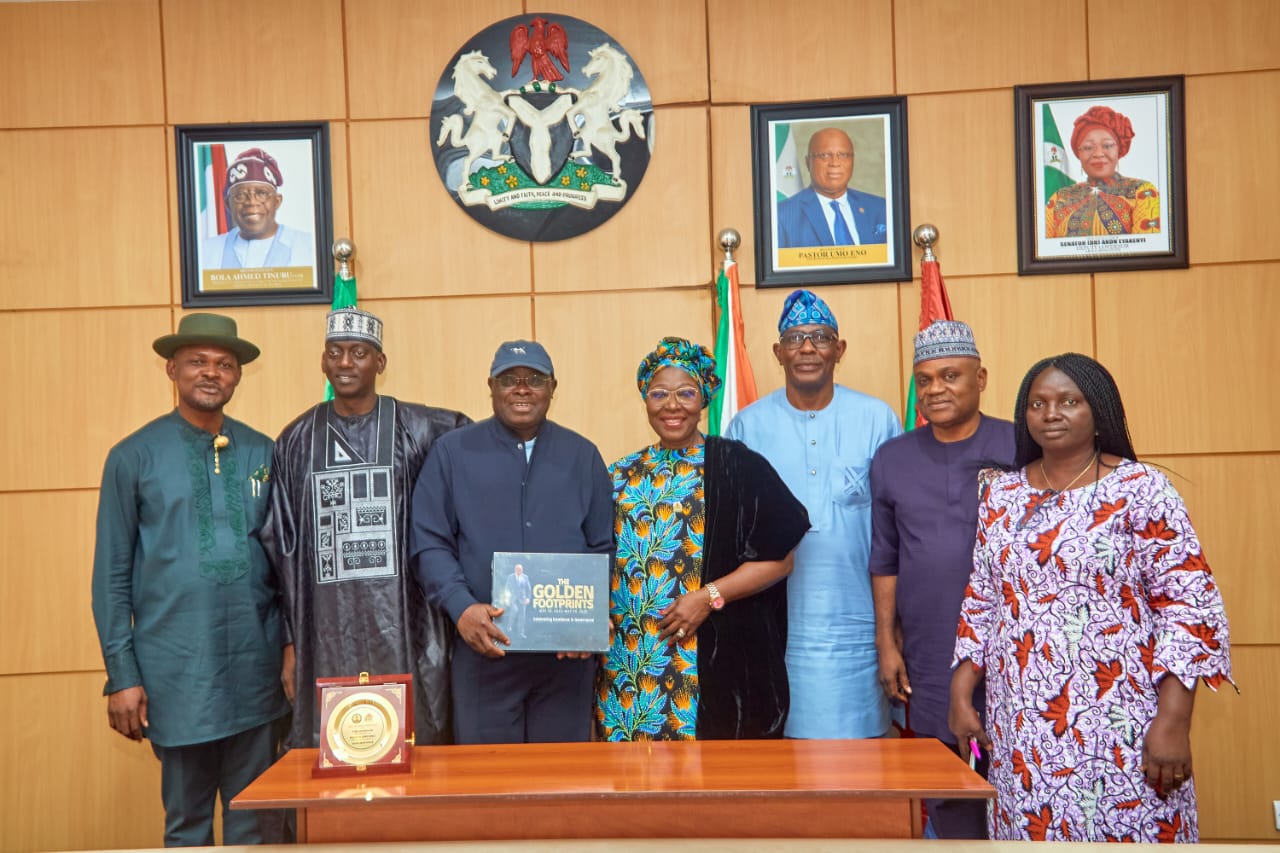
The governor made the commitment while receiving members of the House of Representatives Committee on Public Assets, led by its Chairman, Hon. Ademorin Kuye, at the Executive Council Chambers, Deputy Governor’s Office, Uyo, Wednesday
The federal lawmakers were in the state to undertake an on-the-spot assessment of the abandoned $10 million National Integrated Power Project (NIPP) substation located at Ikot Adiasin in Essien Udim Local Government Area.
Represented by the deputy governor, Senator Dr. Akon Eyakenyi, the governor commended the committee for diligently carrying out its constitutional oversight responsibility across the federation, describing its assignment as vital to national growth and development.
He applauded the unity and dedication demonstrated by members of the committee, noting that their collective commitment reflects the seriousness with which they have approached their national assignment.
According to the governor, the committee’s work was particularly significant because electricity remains the backbone of economic development, industrialization, and improved living standards.
“Power is indispensable to every sector of the economy. Whether for small businesses, schools, hospitals, hotels, or large industries, reliable electricity is essential for productivity and development,” he stated.
Eno also praised President Bola Tinubu for initiating far-reaching reforms in Nigeria’s electricity sector, noting that Akwa Ibom has positioned itself to take full advantage of the new opportunities created by the Electricity Act.
He disclosed that the recently inaugurated Akwa Ibom State Electricity Regulatory Commission has been empowered to drive reforms that will guarantee affordable, efficient, and sustainable electricity supply for residents.
The governor explained that the commission has also been mandated to work towards optimizing the operations of the Ibom Power Plant to improve electricity generation and distribution across the state.
Expressing confidence in the committee’s findings, Eno urged its members to remain focused on their assignment, assuring them that the state government was prepared to collaborate with every relevant institution to ensure the successful completion and utilization of abandoned power infrastructure.
He further applauded the National Assembly for sustaining effective legislative oversight, noting that such interventions have continued to expose neglected public projects requiring urgent government attention.
Reaffirming his administration’s readiness to revive critical infrastructure, the governor assured the delegation that Akwa Ibom would actively pursue strategic partnerships capable of restoring the abandoned power facility and expanding access to electricity.
Eno also emphasized the importance of safeguarding public infrastructure against vandalism, revealing that his administration has strengthened collaboration with community leaders, youth groups, and traditional institutions to protect government projects across the state.
He observed that the deliberate community-based security approach has significantly reduced incidents of vandalism, particularly involving electricity installations such as transformers.
Earlier, chairman of the House Committee on Public Assets, Kuye, explained that the committee’s visit formed part of the National Assembly’s oversight responsibility aimed at identifying abandoned federal projects requiring urgent intervention.
He revealed that the inspection of the Ikot Adiasin facility revealed power infrastructure and equipment valued at over $10 million lying idle for several years despite the enormous public investment committed to the project.
The committee chairman commended the host community for protecting the facility from vandals, contrasting the situation with similar installations in other states that have suffered extensive destruction.
Kuye noted that the Electricity Act signed into law by President Tinubu has fundamentally transformed Nigeria’s electricity sector by granting states greater regulatory authority and investment opportunities.
He explained that Akwa Ibom , as an equity shareholder in the Niger Delta Power Holding Company (NDPHC) project, was strategically positioned to negotiate joint ventures, equity partnerships, and franchise arrangements that would facilitate the completion and operation of the substation.
He, therefore ,urged the state government to direct its Electricity Regulatory Commission to commence discussions with the management of the NDPHC with a view to establishing a joint completion funding arrangement that would provide the outstanding capital required to energize the facility.
According to him, once completed, the substation would serve as a major distribution hub, receive power directly from the Ibom Power Plant, bypass existing national grid constraints, and provide stable electricity supply to communities across Akwa Ibom and neighbouring Cross River State.
The committee chairman also commended Governor Eno for his visionary leadership in the power sector, noting that Akwa Ibom became the first state in Nigeria to domesticate the Electricity Act through the enactment of its own electricity law.
He equally lauded the Commissioner for Power, Hon. Iniobong Robson, and the permanent secretary in the Ministry for facilitating the committee’s inspection tour of the power facility.
The meeting was attended by members of the Akwa Ibom State Executive Council, the chairman and members of the Akwa Ibom State Electricity Regulatory Commission, members of the House of Representatives Committee on Public Assets, including Dr. Patrick Umoh, Hon. Ja’afaru Yakubu and Hon. Olatunji Akinosi, as well as the committee clerk, Mrs. Cordelia Aromosun.