

By Iyoho Emmanuel
ABUJA — Civil society organisations have demanded full transparency and accountability over the proposed $2.5 billion investment by global meat-processing giant, Jose Batista Sobrinho (JBS), in Nigeria, calling for comprehensive environmental assessment, wider government scrutiny and meaningful citizens’ participation before the project proceeds.
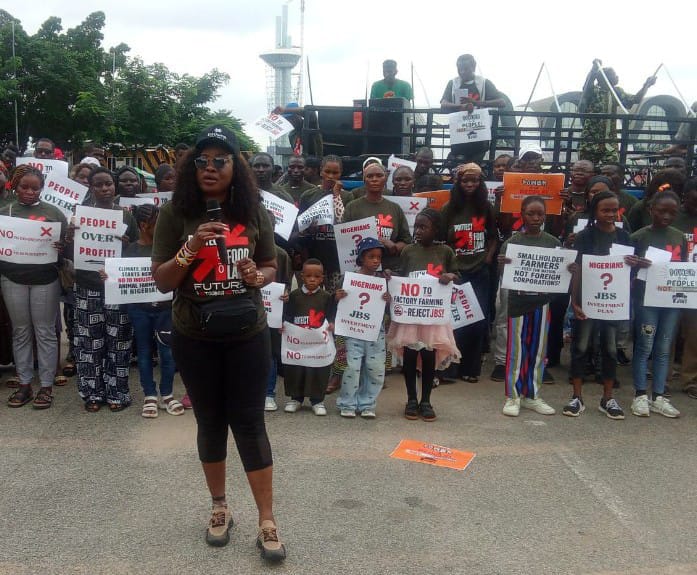
The demand was made during a civil society rally in Abuja under the theme “Protect Our Land, Our Food, Our Future,” where campaigners raised concerns about the potential implications of large-scale industrial animal farming for Nigeria’s farmers, land, water resources, communities, biodiversity, public health, food security and food sovereignty.
According to the background reports as circulated at the rally, JBS signed a five-year, $2.5 billion investment plan with the Nigerian Government in November 2024, involving six proposed facilities ,three poultry plants, two beef-processing plants and one port facility.
The campaigners said the proposed investment should not be judged solely by its financial value or potential to create jobs and stimulate economic development, insisting that adequate safeguards must be put in place to protect the public interest.
Executive Director of Environmental Rights Action/Friends of the Earth Nigeria (ERA/FoE) and Coordinator of the African Regional Stop Financing Factory Farming, Mariann Bassey Olsson, said Nigerians would naturally welcome a multi billion-dollar investment because of its potential economic benefits, but must first ask fundamental questions about its implications.
“When people hear a company is coming to Nigeria and is bringing $2.5 billion, our first reaction is fantastic: jobs, investments, infrastructure, development. But before we celebrate the numbers, we need to pause and ask a fundamental question: what exactly is this investment?” Olsson asked.
She stressed that the groups were not against foreign investment but wanted investment to be people-centred, transparent and protective of public interests.
“We are not against investment. We are not anti-investment. We are saying investment must have a people’s face,” she said.
Olsson called for the disclosure of the agreement or Memorandum of Understanding reportedly signed between JBS and the Nigerian Government, saying Nigerians and relevant experts should be able to examine the terms of the investment.
She also demanded clarification on land allocation and whether an Environmental Impact Assessment (EIA) had been conducted.
“What lands have been allocated? Has EIA been done? What will happen to our water? What will happen to the community? Where would the land be sourced from?” she asked.
Olsson warned that the proposed project was about more than the construction of factories, arguing that it could influence Nigeria’s land, livestock, farmers, feed, water, markets and ultimately the control of the food chain.
She also concerned over the possible effect of large-scale industrial animal farming on smallholder farmers and Nigeria’s food sovereignty.
Director of Programmes, Health of Mother Earth Foundation (HOMEF), Joyce Brown, also called for comprehensive due diligence and environmental assessment before the investment proceeds.
Brown said Nigeria should learn from concerns raised about JBS operations in other countries and establish appropriate structures to protect local communities and the environment.
“We believe that if we are to allow JBS into Nigeria, we must put structures in place to ensure that our people don’t suffer,” she said.
She was worried over the absence, to her knowledge, of evidence that an EIA had already been conducted, while noting reports that land had been allocated in Niger State.
Brown also demanded that the agreement between JBS and the Nigerian Government be made public for review by experts across relevant sectors.
She advocated a multi-agency approach involving the Ministries of Agriculture, Environment and Health, among other relevant institutions, arguing that the proposed investment could affect agricultural production, water resources, public health and local communities.
Brown further called for oversight by the National Assembly, stressing that an investment involving large expanses of land and natural resources should receive appropriate legislative scrutiny.
Meanwhile, Coordinator of Resources Justice Network and Senior Programme Manager with Youth for Change Initiative, Collins Nyong, called for greater citizens’ participation in policies affecting Nigeria’s food system.
Nyong said the advocacy was aimed at drawing the attention of government authorities and lawmakers to the need for transparency and accountability in food-related policies.
He noted that civil society organisations had carried out similar advocacy at the same venue the previous year, describing the renewed campaign as part of their sustained effort to ensure that citizens are carried along in government decisions.
“Last year we were in the same venue to also advocate for the same issue. This year we are also here to advocate. That is to say that we are committed in our advocacy to ensure that there is transparency and accountability in government policy,” Nyong said.
He urged the government to ensure that Nigerians participate fully in decisions concerning food and agriculture.
“My prayer now, one is that there should be transparency and accountability. And the second prayer is that let the citizens be involved in whatsoever that they want to do,” he said.
The campaigners said their concerns extend beyond the proposed JBS investment to the broader issue of industrial animal farming, which they said could raise questions around public health, environmental sustainability, animal welfare, labour rights and socio-economic equity.
They called for transparency, due diligence and ecological safeguards, insisting that Nigeria’s pursuit of foreign investment should not undermine its environment, local farmers, communities or food sovereignty.
The groups maintained that they were not opposed to foreign investment, but demanded that any major investment entering Nigeria should be transparent, accountable, environmentally responsible and structured to deliver sustainable benefits to Nigerians and future generations.